Wednesday, 9 October 2013

'Sacntum' film analysis for thriller ideas.

Thriller text analysis number 2: - 'Sanctum'
 
Sanctum was released on the 4th of Febuary 2011 in the UK.  The film was directed by Alister Grierson.  The film's story line is about a team of underwater divers who try and explore the most unaccessible and the most beautiful caves on earth.  The manage to access this cave and are in the process of exploring it where there is a tropical storm which forces them further into the unknown of the cave.  They must fight to get out or get traped in there forever.


The movie poster itself supplies a sort of 'thriller' - ish scene as it shows the darkness around the diver and the light shining it's way into the unknown which grabs the audiences attention to see where the diver is really going.  The way the titles are also layed out give a sense of it being a thriller as well as there is a bright light on top of the "C", which then illuminates the rest of the title, but as it reaches the "S" and the "M", it starts to fade, suggesting that there is a never ending depth of the gave and there is no way out.  Another thing that supplys a thrilling but yet chilling aspect of the film is the tagline on the title, which says "The only way out is down".  This gives a chilling but yet thrilling sort of aspect to the film as you wonder if there really is a way out when they travel deeper into the cave, and possibly finding an escape route through the cave's maze.   
 
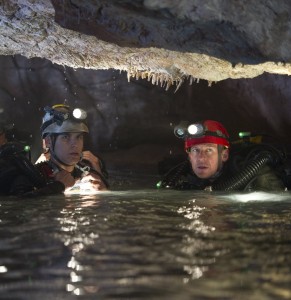
The film itself isn't classed as a "thriller", but is uses techniques that can be used, and would also fit very well in thriller films, such as the claustrophobic spaces and uses of dark and selected lighting.
 

- In this picture, the director uses the technique of claustrophobic scenes to supply a almost uncomfortable and makes it seem that there is 'no hope' of them all getting out as it gets smaller and smaller in each area as the film continues -


The "first time" in the cave

To scenes where there isn't so much space: -


This use of claustrophobia gives the film more suspense and also raises the tension about the fact that you almost feel 'hopeless' for them and that it supplies a thrilling 'fear' of the idea.
 
There is also a use of little to no lighting in the film, which yet again is a good aspect to use in a thriller.  This is a good technique to use as it builds up suspense as you are 'disabled' so see and know what is around the characters in the film, and if they have a light on them like in this film, you'd want them to explore more to build up your senses of the surrounding area.
 
Scenes like these show the tecnhiques used: -


It finally uses techniques to put people on the edge of their seat and thrill them with that is happening as parts of the film is faced paced.  For example: - One part of the film where Victoria (played by Alice Parkinson) has to try and get through the waterfall to reach the next part of the cave, where her other team is trying to help her get up.  Her struggle pays off as she reaches the top where her other 2 team mates are, one helping her up and one holding onto a boulder which is being pushed off the edge of the waterfall, and if it falls, would kill the team if they didn't move on in time.  As she reaches the top and is standing with her other team mate, it almost gives a sense of relief that they're going to be ok, until the boulder is nudged by a big burst of water, causing all 3 team mates to be pushed back off the water fall and into the pool below.  This supplies thrill as it keeps the audience hoping that they'll make it and also put themselves in the action too of fighting the vicious waters.
 
The clip of the waterfall -


Tuesday, 8 October 2013

'One Hour Photo' Film clips and poster analysis

Thriller text analysis number one: - 'One Hour Photo'


The Genre of the film: - Thriller/drama

The film is directed by Mark Romanek and was released in 2002.  The film was originally filmed in the US, but was released in the UK on the 4th of October 2002.  It spent a budget of 12,000,00 (approx.) but reached the highest gross of £1,331.333 on the first screening on the 20th of October in 2002 in the UK. 

The story of this thriller is about a one hour photo lab scientist who becomes deeply obsessed with a suburban family.  He has hardly had any friends but learns from the photographs from his customers that he produces.  He soon becomes obsessed with the Yorkin family and the mother, Nina Yorkin and her adolescent son Jake Yorkin.  One of his obsessions is fantasising about him being their favourite "Uncle Sy", even though he has little/no relation with the family anyway.  He starts to turn depraved over the family, trying to urge imself closer into the family and "linking" himself to them by being their "uncle".  Throughout the film this starts to haunt him and causes him to change for the worst, causing him to turn his obsession into danger, visiting and following the family where ever they go. 

It is a deeply psychological and also tense and chilling thriller as the idea of 'stalking' and the way it makes you feel that you have no privacy while watching the film.

The first analysis of the film would be about the movie poster.  The poster gives a creepy but yet chilling essence to it as on the poster it has the camera which he uses, which is covered in red, which yet would describe the "chilling" essence to it as he stalks the family and takes pictures of them doing their normal life. 

It also shows Robin's face expression (who plays a 'Sy' in the film) with the camera and it looks like it takes up one of his eyes, making the character seem as if it was part of him.  This is takes up half of the poster, grabbing the audiences  attention almost  instantly.  The facial expression of Robbie also gives it a "uncomfortable" feeling to it as if it is an addiction and he can't stop as he obsessed with taking pictures of the family.  It also somehow gives the audience a feeling of sympathy for the character as when you look at his eye, it seems lost and sad as it makes his face look "expressionless", and therefore making the camera seem like it is a "part of him."

Also on Robin's face, it shows his facial expression to be "evil" like as when you look at him at first sight, you see him to be scary as he shows hardly any expression but the camera "creates" most of it as it makes him seem twisted. 

The photo underneath Robin's face shows him standing almost 'casually' but yet 'proudly' in front of a wall of pictures that he took of the suburban family.  This gives a feeling that he is wicked and twisted in what he is doing because his body posture seems to make him look as if he had no remorse in what he is doing.

Film Clips Analysis


The film trailer:
 
Film Critic analysis
 
On IMDb - It scored a rating of 6.5/10 and was reviewed by critics such as Robert Egbert, The Guardian and also The Observer.   On IMDb, most users rated the film a 7 as out of all ratings, 32.4% of all viewers rated it a 7 (25568 ratings), 20.7% (16369 ratings) - 8, 7.3% (5782) -9 and 4.8% (3812) a 10.  Overall, 78908 users averaged the vote of 6.8/10.
 
Robert Egbert linked the film to other thrillers such as 'Peeping Tom'.  With this film he describes it to be a "Profoundly creepy" film as in 'The One Hour Photo', Sy takes pictures of more innocent families, where in 'Peeping Tom', the character actually shows depravity, which shows that he has a condition, where Sy has an addiction.  He also links the film to 'Peeping Tom' as in the 1960's film, he uses a camera but with a hidden stiletto inside which is concealed in the front leg of his tripod, which he records them with the stiletto pointing out at them and get's closer and closer and in the end, kills them.  In 'The One Hour Photo', he describes the camera to have a "psychological stiletto" and he also links the two characters together saying "he's the same kind of character, the sort of man you don't much notice, who blends in, accepted, overlooked, left alone so that his rich secret life can flower", but only separating them by the differences of the stalker in 'Peeping Tom' seeming more deprived and more obvious, than Sy, who blends in more to seem normal until he is close to the family.
 
I agree with this review as it does create a feeling that he does have a 'hidden weapon' in his camera and that in the end he may become so obsessed, that he eventually drives over the edge and into madness and showing it more in public.  I do also agree with him when he says that he "blends in" and that "you don't notice" because in the film he is always mostly a distance away from the family, in 'Peeping Tom', the stalker actually interacts more in his footage that he takes as he also takes videos as well as pictures.  In 'Peeping Tom', the stalker actually kills his victims as well, where in 'The One Hour Photo', he just stalks and tries to link a 'family bond' with the family. 
 
 
'Peeping Tom' Movie poster

Thursday, 26 September 2013

Camera still practices

Worm's eye/low angle shot, portrait - shows the object/animal/person has power over everything else, or show the character in a patriotic and proud way.  May also show fear or build up suspense as you feel small and vunerable against the character.


Worms eye, close up - This may also show the character's status of being powerful, proud, scary or dominant.  But the purpose of the close up may show the inner feeling/detail of the character.


High shot - This may show either how you are stronger than the object, making the object look vunerable or small/weak to you. 


Low angle shot, worm's eye - Shows the importance but also inner - detail or expression of the object.


Over the shoulder shot - Shows what the person is seeing/puts the audience in the view of the character.


Over the shoulder shot -  Shows what the person is seeing/puts the audience in the view of the character.

Friday, 20 September 2013

Damien Walters - Freerunning


I like some of the camera angles and techniques used in this video as they "keep the momentum going" as some of them follow on with Damien as he does the stunts.  This is a good camera angle as it continues the action and gets the audience moving with the stunt man.  Examples like this would be tracking shots as he is running along and performing the stunts.  This is a good way of keeping the momentum going through the video as it lets the audience "run along" with him.

Other camera angles/techniques would be examples such as worm's eye view and also the use of the camera in the corner of the whole scene.  These shots would help show his power or show how small he is from the whole scene.  This helps the audience as it supplies a sense of excitement as the camera's present him as a 'strong' and 'dominant' freerunner

Wednesday, 18 September 2013

Tuesday, 17 September 2013