The best techniques to include in a thriller are the ones to raise suspense
Camera techniques: -
Worms eye view - To show fear or dominance of a character
Close ups/extreme close ups - To show the real expression of the character, and/or to raise tension. The technique could also be used on hands on door handles or reaching out for someone/thing
Over the shoulder - Allows the audience to "be" with the character, - increases suspence as they are also in the characters position.
Long shot - Shows the character in it's surroundings, could be used to increase the suspense to try and make the audience feel cautious of what is going to happen to them.
Use of Threes - To make the audience cautious of what is around them while having the main focus on the main character.
Lighting techniques -
Chiaroscuro lighting - To bring uneasieness or a 'unrealistic'/'dream-like' personality to the character.
Lack of light - To bring about tension or to create an eerie atmosphere.
Noir lighting (possibly) - To contribute to the lack of lighting and the chiaroscuro lighting to being about tension and suspense.
Selective lighitng - The use of light being used in certain places to symbolise an importance of something/someone i.e. the one light shinning over a camera on a table in a dark room, may bring about realization/confusion or bring about tension why that camera is there.
Objects that could be used -
Cameras - The old fashion or digital
Rope
Knives (fake - plastic)
Guns (fake - bb)
(The Camera Robin Williams - "Sy" uses in 'One Hour Photo')
Thriller Planning – What
makes a good thriller? - Case study: ‘Once Upon a time in America’
Director: Sergio Leone
The date the film is set –
1930’s America – Mob and Gangster period
The opening part of the
film is set just before the event of the ban of prohibition (which the Gangster
group took over.)
How the director
introduces the genre: –
Sound – sound bridge: -
The sound adapts the next scene, for example from the film; - His phone rings
and this then moves to the next scene with the continuum of the phone ringing,
symbolising a flashback/dream of what the phone ring made him see.
Diegetic and Non –
Diegetic sound
Diegetic sound –
The sound the actors hear.
Non – diegetic sound
– Sound that has been added during the edit.
Lighting – A lot of dark
areas in scenes, Chiaroscuro lighting – dark areas with selective interest of
lighting.
How the director
establishes the genre of the film: -
·Lighting – Mostly
Ambient and Noir lighting – Black and white lighting.He also uses Chiaroscuro lighting to give an
unrealistic or dreamy atmosphere. ·Locations –
Apartment blocks, bars, lifts and alleyways. He uses this to create an atmosphere of “being
trapped” or the claustrophobic feeling. ·Character types –
Gangster type character – Big, bold, strong and scary.He has a ‘Femme Fatale’ who seems innocent
but is actually dangerous.The name of
the Femme Fatale is Eve – symbolically meaning of ‘evil’ or ‘devious’. ·Costumes –
Gangster and the police outfits are very similar as they both wear the classic
1930’s American suits, top hats and waistcoats.This would represent corruption in the two sides as gangsters would
sometimes work with the police in the jobs. ·Props – Hats,
guns, other equipment such as a punch bag. ·Objects – Guns –
used to bring action and tension ·Suspense – Mostly
created through sudden, tense or unexpected moments happening when least
expected.Also slow, silent parts of the
film; - for example in the film where they are in the bar, Noodles presses the
button to call the lift, as the lift is coming down, it attracts the police officers
attention (who is working with the gangsters), he then moves to the door to
cover him for anyone who comes out of the lift.The lift then stops, causing him to relax, but is then shot in the head
by Noodles who appears behind him. ·Action – The main
action used in the film is the idea of Murder. ·He also uses
music – the song played – ‘God Bless America’ is supposed to represent America
as a peaceful and social country, but in the film it is as an ironic feature as
in the film it is very much the opposite as there are drugs and violence/murder. ·He also uses
hidden/small features on the characters, for example – At the start, Eve enters
her apartment and it is basically pitch black as there are no lights on, she
then walks into the light, which automatically shows up the pearls that she is
wearing, which represent bad luck, making the audience feel cautious that
something is bad that is going to happen.
The stereotypical gangster costume established in the film -
Tom borrows money from Connor but fails to pay him on the day he is suppose to, but as well as Tom borrowing money, Connor has also borrowed money from Rajmund, which he gave to Tom, and Rajmund wants his money back as well.
Locations used: -
1. The doorway to the hall
2. Hallway
3. The editing room
Themes used in the conversation: - anger, threat, nervousness, confussion, anxiety
How is it dramatic? - The cliffhanging threat issued to Tom by Connor about Tom paying for Connors' health insurance and how Tom then asks to himself about him paying Connors insurance, and then it fading to black.
Shot list: -
1. Pan of the school area + pan of Tom running through the doors into the hall
2. Tracking shot of Tom running past the camera
3. Birds eye view of Tom running down the hall
4. Worm's eye view of Tom running past the camera
5. Over the shoulder shot of Tom walking towards the room
6. Close up zoom of his hand trying to open the door
7. Use of Threes to show Tom walking away and the door opening behind him
8. Medium zoom of Tom walking through the door to Connor
9. (main conversation) - Shot reverse shot between Tom and Connor - Tilted camera on Toms' lines
10. (sudden action) Close up zoom when Connor gives the dramatic speech and leaves
11. Close up zoom on Tom as he gives the final speech to himself, then fades to black.
Silent Witness is a British crime drama/thriller series which first started showing on the 21st of Febuary 1996. It has been viewed across Europe as well as it has been viewed in Denmark, Sweden, UK, Far East and Latin America. The series was created by Nigel McCrery a former murder squad detective in
Nottingham. There was a total of 332 episodes from 1996 - 2012.
This TV series used a great range of thriller techniques as it tried to include and build up suspsense in audience to try and make them almost be urgent to find who the criminal is. The series used a great range of techniques and story lines to build up tension through out episodes. One of the techniques the mostly used was the 'use of threes' technique, for example -
The technique used keeps the audience seeing everything around them, but still holding their attention to the main character. In this scene, William Gaminara - Professor Leo Dalton, is trying to think about the case of the murder (pictured behind him), and the 'use of threes' shows that he is thinking about just that aspect, and almost 'blocking' everything else out around him. The image behind Leo also supplies a 'chilling' aspect of the murder as it is almost watching him while the technique(use of threes) is happening.
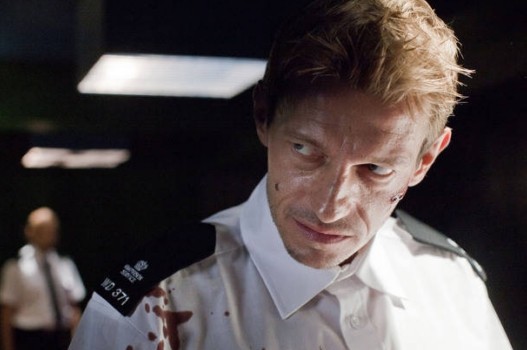
Silent Witness also uses a lot extreme and normal close ups. This is to show and create suspense as it shows the true and possibly hidden emotion in a character. An example of this would be from the episode 'Redhill' where the police officer is at the scene and he almost suddenly shows evil by the way he looks, the amount of lighting and also the use of the close up, -
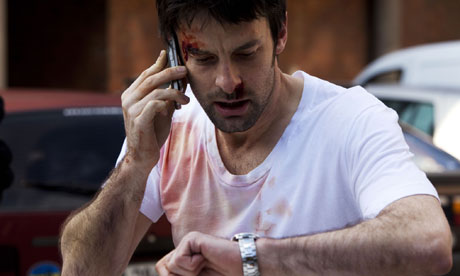
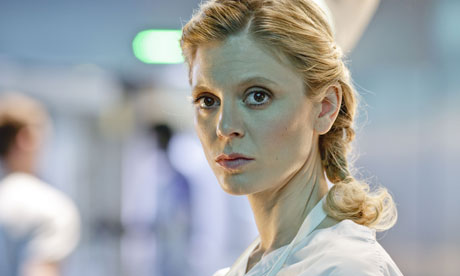
More examples of close ups used in the show: -
These close ups show/may show how desperate a character is, for example - the first picture, Dr Harry Cunningham (played by Tom Ward) is against time to try and get hold of the rest of the team as he is looking at his watch and on the phone at the same time. He also shows a desperate look as if he is worried that what has happened to him/the people in the area. The second picture, shows Dr Nikki Aexander (played by Emilia Fox) as an "important" character as there is light shining down on her, the camera is basically only focusing on her, and bluring everything else around her. This may show that she knows something which would help the investigation, or that something has happened and she is curious as almost all of her face is in the shadow, and only part of her face is in the light, which may also possibly show anxiousness.
Ratings and Reviews of Silent Witness:
Many users on IMDb gave it an overall rating of 7.4/10 with very positive comments, such as; - 'amazing show' and 'Great British drama'. These reviews have also been coming from different countries, such as Canada, Australia and from the Netherlands. However, some reviews are negative as some people think that the show has started to 'sink' and it has gotten old. Personally, I think the show was very good as it built up tension in every episode and it gave a good "thrill" and insight to what they do and how crimes are solved. I do however think that it has been going for too long and they may have reached a dead end to where they will need to start thinking of stopping as it is starting to fade out and the crimes are getting a bit repetitive and unnecessary.
In the Guradian, reviewer John Grace reviewed the program in both positive and negative ways as he thought that the new series of the program led to new cases and better 'whodunnit' moments, but yet he thinks that there are some rather 'disconcerting' moments as he says - "To find him gunned down by police on his own doorstep inside 30 minutes after threatening to go berserk with a shotgun was truly disconcerting." John also gives positive comments to the characters, for example with Nikki, he says that "Also impressive was Nikki's mental disintegration: not the usual over-the-top, unconvincing, hysterical affair you tend to get in TV drama, but a gradual loosening of the fingernails as they try to cling ever tighter to reality." This shows that they have improved on the characters to present more of a 'picture' about them and it allows the audiences to get to know the characters more. I agree with most of Johns' review as I find it does make a good 'whodunnit' night and the moments are very well planned out for them. However I also agree with what he says about the "disconcerting moments" as many of the crimes may represent a realistic view on what really happens in the world, but also a very graphical and 'horrific' view as well.
Question 1 - What planning did you do for your filming task? And how did this planning aid the filming? -
I planned my preliminary task through storyboards, shot lists, clothing lines and keeping the dramatic part of the scene the same. Using the storyboards helped us with the filming as it enabled us to remember where we left off, what we still need to do and also it gave us an idea of how the story would turn out. This improved the filming as it made it easier to do. Shot lists and clothing lines helped us with the filming as it kept us organised with what we were doing. When we followed the clothing line and shot list, hardly any shots were repeated because we stuck to the lists, making it easier to complete the task and put it all together, while using a range of different shots. The final part of out planning was to keep the dramatic ending the same. This would help our filming as it would fit in with the story line and would also make us keep the same story line and not change, but improve it, as it would take too long if we had to change everything. Question 2 - What is the 180 degree rule? And how is this rule important in the filming task? -
The 180 degree rule is used where there is a shot reverse shot conversation or a when filming two objects in the same room. The rule is important in filming because if the rule is broken and the camera passes the 180 degree line between the two characters, the audience then becomes disorientated, making it seem as if they have switched places. It is important to not break the rule as you want to keep the audience weary of what is going on and not confuse them, because otherwise, it can get confusing and not make sense. Question 3 - What shot types and camera angles did you use in your filming task, and to what effect?-
We used a range of shot types in our film, such as: - Worms' Eye, High/birds eye shot, Over the shoulder shot, close up, medium close up, extreme close up, pan and 'use of threes'.
These shots created a wide range of atmosphere and effect.Worms' eye view was to create a 'dominant' or 'fearful' atmosphere, in our film we used it to create a 'desperate' effect as the character running was in a lot of trouble and needed to get to the meeting area fast. The bird's eye view was used to also create a similar effect of 'nervousness' but was used to make the main character look smaller and yet more vunerable. The over the shoulder shot was used in our film to create an effect of the audience seeing that the character sees and put them in the situation. The different ranges of close ups; - Extreme, close and medium all showed the characters emotions and brought more drama to the scenes as it builds up tension as the audience can then see the true expression in the characters face. The pan shot was used as an opening of our film as it was used to show the area that it was held and to give an audience a view of what is in the area, and what it is like. The final shot we used was the 'use of threes', this shot was used to spark up tension again as in the film it shows the character walking away from the door which he failed to open, the door is then opened as he walks away (and is almost out of the shot). The character is then realises that it is not over and the tension keeps building as he enters the room to find the other character waiting for him. Question 4 - What editing skills have you developed? How confident are you with the editing program? -
I have developed a lot of new editing skills such as clipping films at specific moments and binding the film together from part by part. I have also learned how to use certain effects like 'fade to black' as I have learned how it effects the film, and also how to put the effect in the right place.
I have used a range off effects to improve my media blog through adding 'meanings' and atmospheres to the film. For example; - I used black and white for the first half of the film to provide a dream like or dramatic moment as all the colour is stripped away. There is then a "break" in half of the film as there is a flash of light, and then leaving the rest of the video on colour. This may show that there has been a 'burst' of reality that has just hit the character and it has become more tense as the audience can now see the reality and all the colour, instead of black and white. I also used dissolve transitions in the video to continue the suspense of the character running, instead of it just cutting to the next part. I have also used dissolve to create an atmosphere of the character running forever as the scenes keep disappearing into each other, creating a effect of the character running into the next scene. The final effect I used was slow motion, this effect was used to emphasise the action of the character, - for example; - Connor closed the door in slow motion at the end, which was dramatic, and it also slowed down time for the audiences viewing so that they can take it in.
I am very confident with the editing program as it becomes easy with the basic tools such as the 'razor' tool (which cuts film clips at the parts you want). I have also built up confidence in the program when binding films together, clip by clip as you have to spend time and concentrate on it, which in the end gets easier with practice as you have two playing screens to help you find the specific moment.
The areas I would need to improve on however with my confidence is to get the right effects in the right parts of the film.
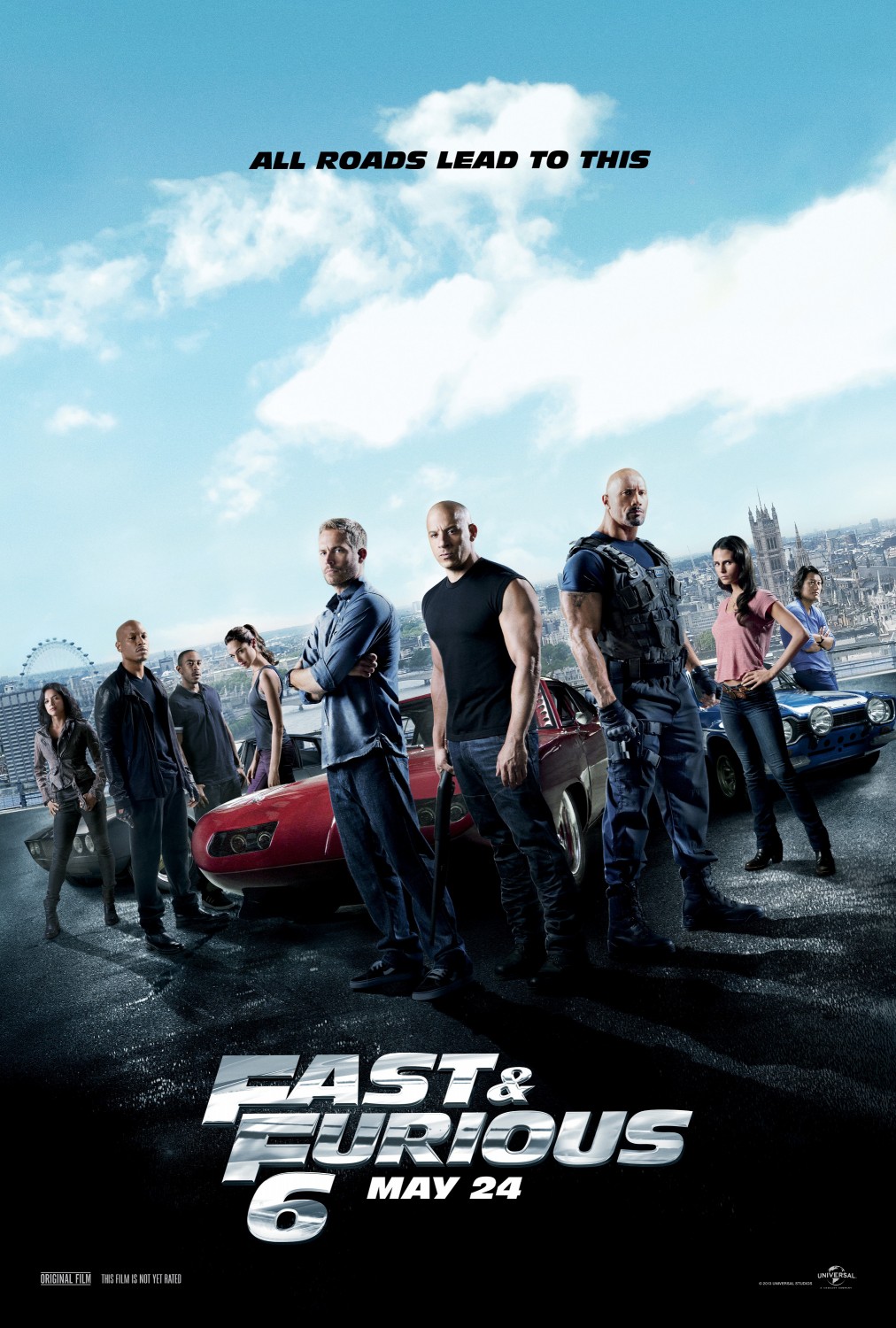
Thriller text analysis no. 3 - 'Fast and Furious 6'
Fast and Furious 6 was released on the 17th of May, 2013. The film spent a budget of $160,000,000, but reached a grossing of $238,673,370 from it's first screening on the 30th of August 2013. The film is directed by Justin Lin. The film's storyline continues from the 5th after a successful heist of $100,000,000. The crew then get a shock report of a criminal who leads a gang of mercenary drivers across 12 countries. They have to work with elite forces who tried to take them down in the 5th film. The crew battle against an old friend who was part of their team who was thought to be killed in the 4th film. The member (Letty) actually survived the car explosion due to purpose misfire but then lost her memory and was then 'adopted' by the gang leader, Shaw, an ex - SAS officer (played by Luke Evans), who then used her disability against her to join his gang. The team and the elite forces have to team up to bring back Letty, and take down Shaw before he escapes.
The film is a good thriller as the team and the elite forces have to fight through and against Shaw's team to eventually get to him. The film leads on as the team fail to catch Shaw due to their cars, technology and tactics. The team also fight and plan to get better cars to catch Shaw in the end.
The techniques the film uses that make it a good thriller is to keep the story going. There are moments in the film where people think the film is going to end because they may have gotten extremely close or actually caught Shaw, but then an event lets him get away. In this film, Shaw tells Dom (Vin Diesel) That he "Can reach out and break him whenever he wants", and that he tells him that he better leave or his family is involved. The audience then 'forgets' Shaw tells Dom this and near the end where they do capture him, Shaw then reminds Dom that he is stronger and yet he "can reach out and break him", which then automatically alerts the audience about Dom's family, which then shows the audience that Shaw's team kidnaps Brian's family, - his wife and child. He then blackmails them to letting him go or Brian's family would be harmed. They then did, letting him go with the rest of his crew. This then leads on to the 'real end' as they then race to stop Shaw and his crew escaping on a plane holding illegal stash, which is fast paced and action packed, keeping the audience on the edge of their seats. The film finally ends as they kill Shaw, but also lose team members, who played a part in the earlier series, (for example - Gisele, played by Gal Gadot).
The way the film also provides thrill by the fast paced car scenes and the stunts used. This makes it fast paced and thrilling as it keeps the audience at the edge of their seats. The use of the cars and the scenes i.e. the traffic infested cities like London and the highways in the US provide a fast paced and on the edge of the seat action because of the fast driving and the way they weave between cars and on opposite sides of the road, driving straight at oncoming traffic.
Some examples of this would be: -
1. Mersey Tunnel Chase Scene between Dom's team and Shaw's
2. Tank chase scene : -
It also features breath taking moments such as Dom's leap and catches Letty : -
In the moment where Dom saves Letty uses a lot of fast heart pumping action as the lead up to the big event, there are two events happening; - Brian is trying to push the car off the bridge to cause the tank to flip, and Shaw tells Letty as this is happening, to try and disconnect the cable from the tank. This creates a adrenaline moment as it keeps you on the edge of your seat to what would happen to Letty if the car creates the tank to flip, which then leads up to the big moment. The final part where Dom catches Letty, gives an almost "breath taking" moment as it happens in slow motion as they are both in the air and Dom is heading for Letty to catch her over the gap in the bridge. When he does and as he crashes in the car taking the fall for her, it almost leaves the audience stunned by his bravery and what he did to save her.
Movie ratings and reviews
Overall, from the viewers, the film scored a 7.2 out of 10, but was yet rated 6.2/10 by metascore. The users thought that the film was 'enjoyable' but also the 'no different' to the other films in the series. I agree when the review was rated 'enjoyable' as there were two huge twists to the film; - 'Letty's fake death' and how Han is still alive, although he was seen to de in the explosion in 'Tokyo Drift' (the "3rd" F&F, which actually turned out to be a separate franchise to the original movie, as Han moves to Tokyo after the death of his lover in number 6). However, I disagree where it says about it 'being the same' as it is different as in all the others, they are seen as the 'untrusted criminals', but in this they are seen as the heroes gaining respect for what they are doing, and also working with the police.
The guardian also rated this film a 3/5, and said that "Silly but enjoyable, this sixth instalment of the franchise surprisingly still has fuel in the tank." The critic who is with the guardian, Peter Bradshaw criticised it to say that - "The number 6 is not a reassuring sight, whether it's Police Academy 6: City Under Siege, three 6s on the infant Damien's scalp, or the 1990s New Labour adviser Perri 6. But despite being the sixth movie in the petrol-head franchise starring Paul Walker and Vin Diesel, this film's got a fair bit in the tank; it's silly but enjoyable." I agree and disagree with this rating as I feel that they had improved a lot through the storyline, the unpredictable parts and also the stunts that brought the film together, however, I still felt that the film was very enjoyable with the humour and the fast-paced action in the film.
Han's death in Tokyo Drift (orignal clip from the film): -
The ending after the credits of F&F 6, the cliff-hanger and the surprise ending.
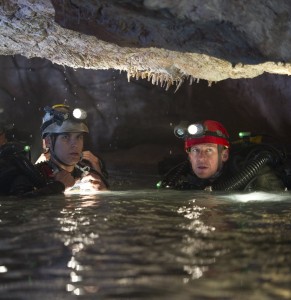
Sanctum was released on the 4th of Febuary 2011 in the UK. The film was directed by Alister Grierson. The film's story line is about a team of underwater divers who try and explore the most unaccessible and the most beautiful caves on earth. The manage to access this cave and are in the process of exploring it where there is a tropical storm which forces them further into the unknown of the cave. They must fight to get out or get traped in there forever.
The movie poster itself supplies a sort of 'thriller' - ish scene as it shows the darkness around the diver and the light shining it's way into the unknown which grabs the audiences attention to see where the diver is really going. The way the titles are also layed out give a sense of it being a thriller as well as there is a bright light on top of the "C", which then illuminates the rest of the title, but as it reaches the "S" and the "M", it starts to fade, suggesting that there is a never ending depth of the gave and there is no way out. Another thing that supplys a thrilling but yet chilling aspect of the film is the tagline on the title, which says "The only way out is down". This gives a chilling but yet thrilling sort of aspect to the film as you wonder if there really is a way out when they travel deeper into the cave, and possibly finding an escape route through the cave's maze.
The film itself isn't classed as a "thriller", but is uses techniques that can be used, and would also fit very well in thriller films, such as the claustrophobic spaces and uses of dark and selected lighting.
- In this picture, the director uses the technique of claustrophobic scenes to supply a almost uncomfortable and makes it seem that there is 'no hope' of them all getting out as it gets smaller and smaller in each area as the film continues -
The "first time" in the cave
To scenes where there isn't so much space: -
This use of claustrophobia gives the film more suspense and also raises the tension about the fact that you almost feel 'hopeless' for them and that it supplies a thrilling 'fear' of the idea.
There is also a use of little to no lighting in the film, which yet again is a good aspect to use in a thriller. This is a good technique to use as it builds up suspense as you are 'disabled' so see and know what is around the characters in the film, and if they have a light on them like in this film, you'd want them to explore more to build up your senses of the surrounding area.
Scenes like these show the tecnhiques used: -
It finally uses techniques to put people on the edge of their seat and thrill them with that is happening as parts of the film is faced paced. For example: - One part of the film where Victoria (played by Alice Parkinson) has to try and get through the waterfall to reach the next part of the cave, where her other team is trying to help her get up. Her struggle pays off as she reaches the top where her other 2 team mates are, one helping her up and one holding onto a boulder which is being pushed off the edge of the waterfall, and if it falls, would kill the team if they didn't move on in time. As she reaches the top and is standing with her other team mate, it almost gives a sense of relief that they're going to be ok, until the boulder is nudged by a big burst of water, causing all 3 team mates to be pushed back off the water fall and into the pool below. This supplies thrill as it keeps the audience hoping that they'll make it and also put themselves in the action too of fighting the vicious waters.
Thriller text analysis number one: - 'One Hour Photo'
The Genre of the film: - Thriller/drama
The film is directed by Mark Romanek and was released in 2002. The film was originally filmed in the US, but was released in the UK on the 4th of October 2002. It spent a budget of 12,000,00 (approx.) but reached the highest gross of £1,331.333 on the first screening on the 20th of October in 2002 in the UK.
The story of this thriller is about a one hour photo lab scientist who becomes deeply obsessed with a suburban family. He has hardly had any friends but learns from the photographs from his customers that he produces. He soon becomes obsessed with the Yorkin family and the mother, Nina Yorkin and her adolescent son Jake Yorkin. One of his obsessions is fantasising about him being their favourite "Uncle Sy", even though he has little/no relation with the family anyway. He starts to turn depraved over the family, trying to urge imself closer into the family and "linking" himself to them by being their "uncle". Throughout the film this starts to haunt him and causes him to change for the worst, causing him to turn his obsession into danger, visiting and following the family where ever they go.
It is a deeply psychological and also tense and chilling thriller as the idea of 'stalking' and the way it makes you feel that you have no privacy while watching the film.
The first analysis of the film would be about the movie poster. The poster gives a creepy but yet chilling essence to it as on the poster it has the camera which he uses, which is covered in red, which yet would describe the "chilling" essence to it as he stalks the family and takes pictures of them doing their normal life.
It also shows Robin's face expression (who plays a 'Sy' in the film) with the camera and it looks like it takes up one of his eyes, making the character seem as if it was part of him. This is takes up half of the poster, grabbing the audiences attention almost instantly. The facial expression of Robbie also gives it a "uncomfortable" feeling to it as if it is an addiction and he can't stop as he obsessed with taking pictures of the family. It also somehow gives the audience a feeling of sympathy for the character as when you look at his eye, it seems lost and sad as it makes his face look "expressionless", and therefore making the camera seem like it is a "part of him."
Also on Robin's face, it shows his facial expression to be "evil" like as when you look at him at first sight, you see him to be scary as he shows hardly any expression but the camera "creates" most of it as it makes him seem twisted.
The photo underneath Robin's face shows him standing almost 'casually' but yet 'proudly' in front of a wall of pictures that he took of the suburban family. This gives a feeling that he is wicked and twisted in what he is doing because his body posture seems to make him look as if he had no remorse in what he is doing.
Film Clips Analysis
The film trailer:
Film Critic analysis
On IMDb - It scored a rating of 6.5/10 and was reviewed by critics such as Robert Egbert, The Guardian and also The Observer. On IMDb, most users rated the film a 7 as out of all ratings, 32.4% of all viewers rated it a 7 (25568 ratings), 20.7% (16369 ratings) - 8, 7.3% (5782) -9 and 4.8% (3812) a 10. Overall, 78908 users averaged the vote of 6.8/10.
Robert Egbert linked the film to other thrillers such as 'Peeping Tom'. With this film he describes it to be a "Profoundly creepy" film as in 'The One Hour Photo', Sy takes pictures of more innocent families, where in 'Peeping Tom', the character actually shows depravity, which shows that he has a condition, where Sy has an addiction. He also links the film to 'Peeping Tom' as in the 1960's film, he uses a camera but with a hidden stiletto inside which is concealed in the front leg of his tripod, which he records them with the stiletto pointing out at them and get's closer and closer and in the end, kills them. In 'The One Hour Photo', he describes the camera to have a "psychological stiletto" and he also links the two characters together saying "he's the same kind of character, the sort of man you don't much notice, who blends in, accepted, overlooked, left alone so that his rich secret life can flower", but only separating them by the differences of the stalker in 'Peeping Tom' seeming more deprived and more obvious, than Sy, who blends in more to seem normal until he is close to the family.
I agree with this review as it does create a feeling that he does have a 'hidden weapon' in his camera and that in the end he may become so obsessed, that he eventually drives over the edge and into madness and showing it more in public. I do also agree with him when he says that he "blends in" and that "you don't notice" because in the film he is always mostly a distance away from the family, in 'Peeping Tom', the stalker actually interacts more in his footage that he takes as he also takes videos as well as pictures. In 'Peeping Tom', the stalker actually kills his victims as well, where in 'The One Hour Photo', he just stalks and tries to link a 'family bond' with the family.